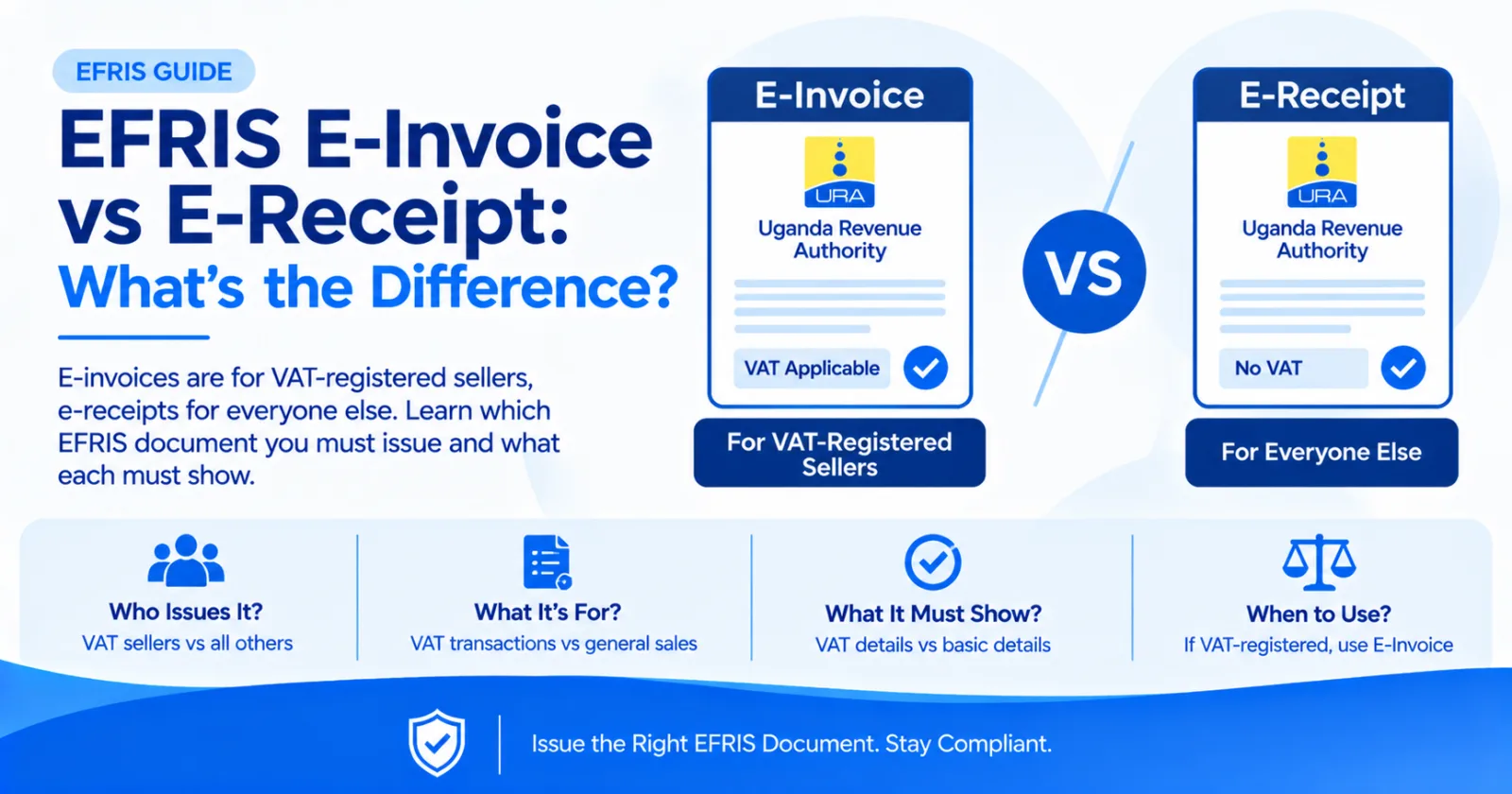
E-invoices are for VAT-registered sellers, e-receipts for everyone else. Learn which EFRIS document you must issue and what each must show.
"Should I issue an e-invoice or an e-receipt?" is one of the most common EFRIS questions, especially since non-VAT businesses in the twelve designated sectors came into the system in July 2025. The answer depends on one thing: whether you, the seller, are registered for VAT.
The main difference is that an e-invoice is issued by VAT-registered businesses, while an e-receipt is issued by businesses that are not registered for VAT.
1. Who issues it?
E-invoice: Issued by VAT-registered businesses.
E-receipt: Issued by businesses that are not registered for VAT.
2. Does it show VAT?
E-invoice: Shows the applicable VAT rate and amount charged on the sale.
E-receipt: Does not charge or show VAT because the seller is not VAT-registered.
3. Can the buyer claim input VAT?
E-invoice: A VAT-registered buyer may claim input VAT, provided the purchase qualifies and the invoice meets URA requirements.
E-receipt: Cannot be used to claim input VAT because no VAT is charged.
4. Can it support an income tax deduction?
E-invoice: Can support an allowable business expense.
E-receipt: Can also support an allowable business expense where the seller is required to use EFRIS.
5. What fiscal information does it contain?
Both documents contain:
Fiscal Document Number (FDN).
Verification code.
QR code for verification.
Important: Both e-invoices and e-receipts are valid EFRIS fiscal documents. An e-receipt is not an informal or inferior document simply because the seller is not VAT-registered.
URA's FY 2026/27 handbook puts it plainly: an e-invoice is "ONLY issued by a person who is registered for VAT", and an e-receipt is issued by "a taxpayer who is not registered for VAT".
An e-invoice has four sections:
Seller and buyer details: seller's name, TIN and address, and the buyer's name and TIN (or NIN/BRN) for business sales.
Goods and services: each item with its description, quantity, unit of measure and unit price, using the product configured in EFRIS.
Tax details: tax category per item (standard-rated 18%, zero-rated or exempt) and the VAT amount.
Summary: net amount, total VAT and gross total. The fiscal block carries the FDN, verification code and QR code.
An e-receipt carries seller and buyer details, goods or services, and a summary, plus the same FDN, verification code and QR code. Because the seller isn't VAT-registered, it doesn't charge VAT. Never add VAT to an e-receipt. Charging VAT when you're not registered is a separate problem.
You issue e-invoices, even to final consumers without a TIN. The buyer section simply shows a walk-in or final consumer buyer type. Being VAT-registered means every sale is an e-invoice.
You issue e-receipts for every fee. If your client is a business, put their TIN, NIN or BRN on the receipt so they can deduct the cost.
From your VAT effective date, switch from e-receipts to e-invoices and start charging VAT. Make sure your POS or EFRIS settings reflect the change on the right date.
If you're in a designated sector, you stay on EFRIS but switch to e-receipts from the deregistration date. If you're not in a designated sector, EFRIS becomes voluntary.
These correct an original document:
An e-credit note cancels or reduces a previous sale, for example when goods are returned or a price was overstated.
An e-debit note increases a previous sale where the value, quantity or tax was understated.
Both reference the original document's FDN. See EFRIS Credit Notes and EFRIS Debit Notes.
Quotations, proforma invoices, delivery notes and order confirmations don't need to be fiscalised, because no sale has happened yet. Don't let a proforma stand in for the final invoice. Once the sale is made, issue the e-invoice or e-receipt.
If your invoices come from accounting or business software, the integration should issue the right document type from your VAT status, so staff never have to choose. EFRIS Simplified submits each invoice from your existing system to URA and returns the FDN and QR code, keeping tax rates and commodity codes in sync with EFRIS.
No. E-invoices are only for VAT-registered sellers. Non-VAT sellers issue e-receipts.
Yes. Where the seller is required to use EFRIS, a valid e-receipt is exactly what the buyer needs to support the expense under Section 22(3)(m) of the Income Tax Act.
No. You can print it or send it electronically. What matters is that it was fiscalised and carries the FDN and QR code.
Share this article