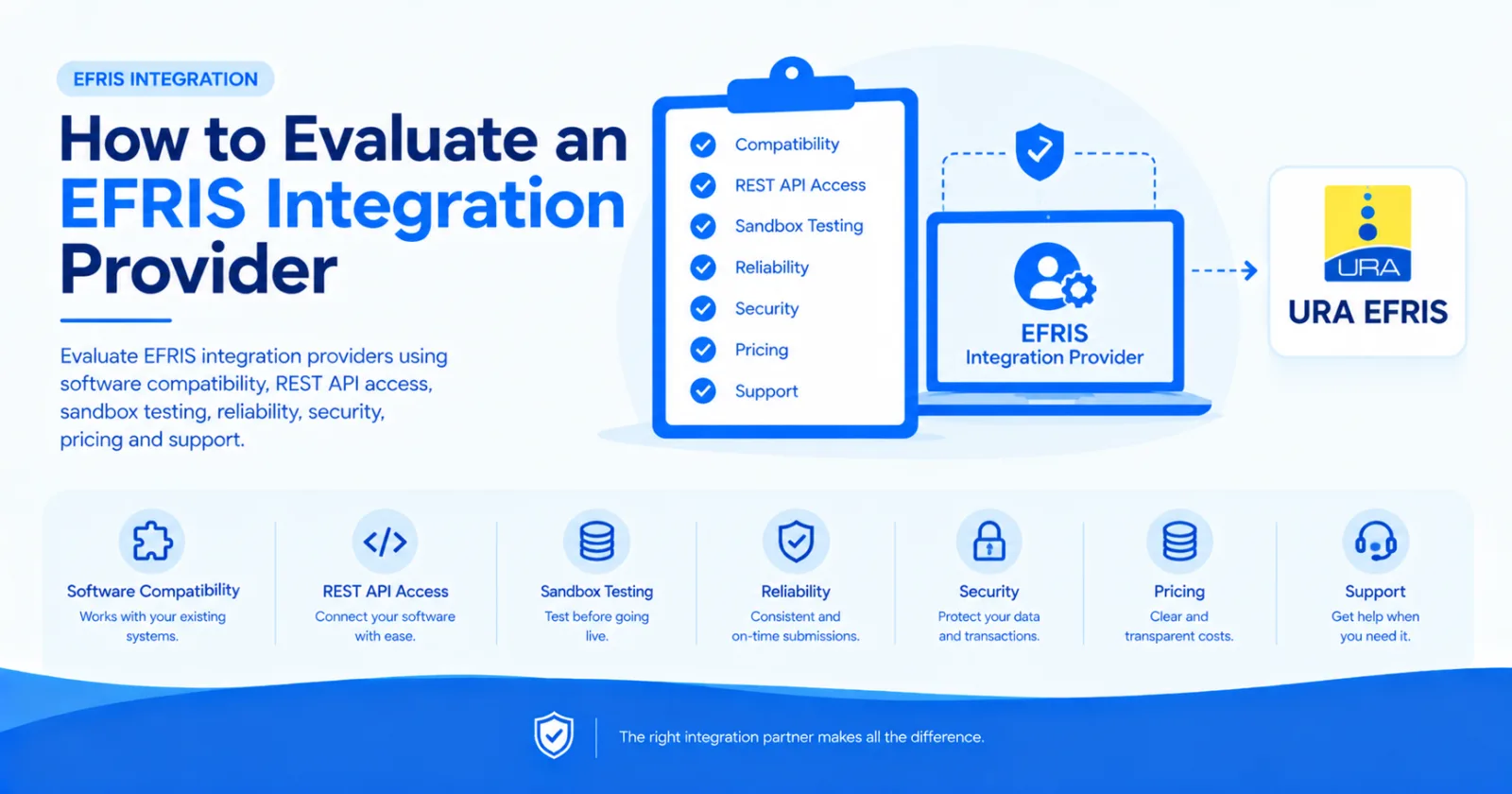
Evaluate EFRIS integration providers using software compatibility, REST API access, sandbox testing, reliability, security, pricing and support.
An EFRIS integration provider should do more than demonstrate that an invoice can be sent to URA.
The provider must be able to support your business systems, transaction volumes and operational requirements over the long term.
Use the following criteria when evaluating EFRIS integration providers in Uganda.
Determine whether the provider can connect to your existing software.
This might include:
Accounting software
ERP systems
POS applications
Ecommerce platforms
Inventory systems
Custom business software
A flexible provider should not force you to replace a system that already works for your organisation.
Ask how data moves between your software and EFRIS.
Is the integration automatic, file-based, manual or API-driven?
For custom applications, a REST API is usually the most flexible approach.
EFRIS Simplified offers an API that allows developers to connect their own ERP, POS and business applications.
A professional provider should support testing before production.
A sandbox allows developers to verify transaction structures, error handling and application behaviour without using live customer data.
Ask how the platform handles failed submissions.
Your team should be able to identify whether a transaction was successful, rejected or still pending.
The provider should also explain how errors are investigated and corrected.
EFRIS integrations process sensitive business and customer information.
Ask how credentials, API keys and transaction data are protected.
Access to the integration should be limited to authorised users and systems.
Evaluate the quality of communication before signing a contract.
Find out:
Which support channels are available
Who handles technical issues
Whether onboarding assistance is provided
How failed transactions are escalated
Whether developer support is available
Request a complete breakdown covering setup, subscription, support, branches, businesses, users and transaction limits.
A lower initial cost may not represent better value if essential features are charged separately.
Choose a provider that can support the business as it grows.
The integration should be able to accommodate additional branches, systems, transaction volumes and registered businesses.
EFRIS should not be an occasional side service.
A provider focused on EFRIS integration is more likely to offer the infrastructure, documentation and support necessary for reliable long-term operation.
EFRIS Simplified is built specifically to connect existing business systems to URA EFRIS.
The platform supports standard integrations and provides a REST API for custom software.
Do not evaluate an EFRIS provider only on the demonstration or initial price.
Consider reliability, support, compatibility, scalability and maintenance.
The right provider should reduce your workload and make EFRIS a natural part of your existing business process.
Share this article