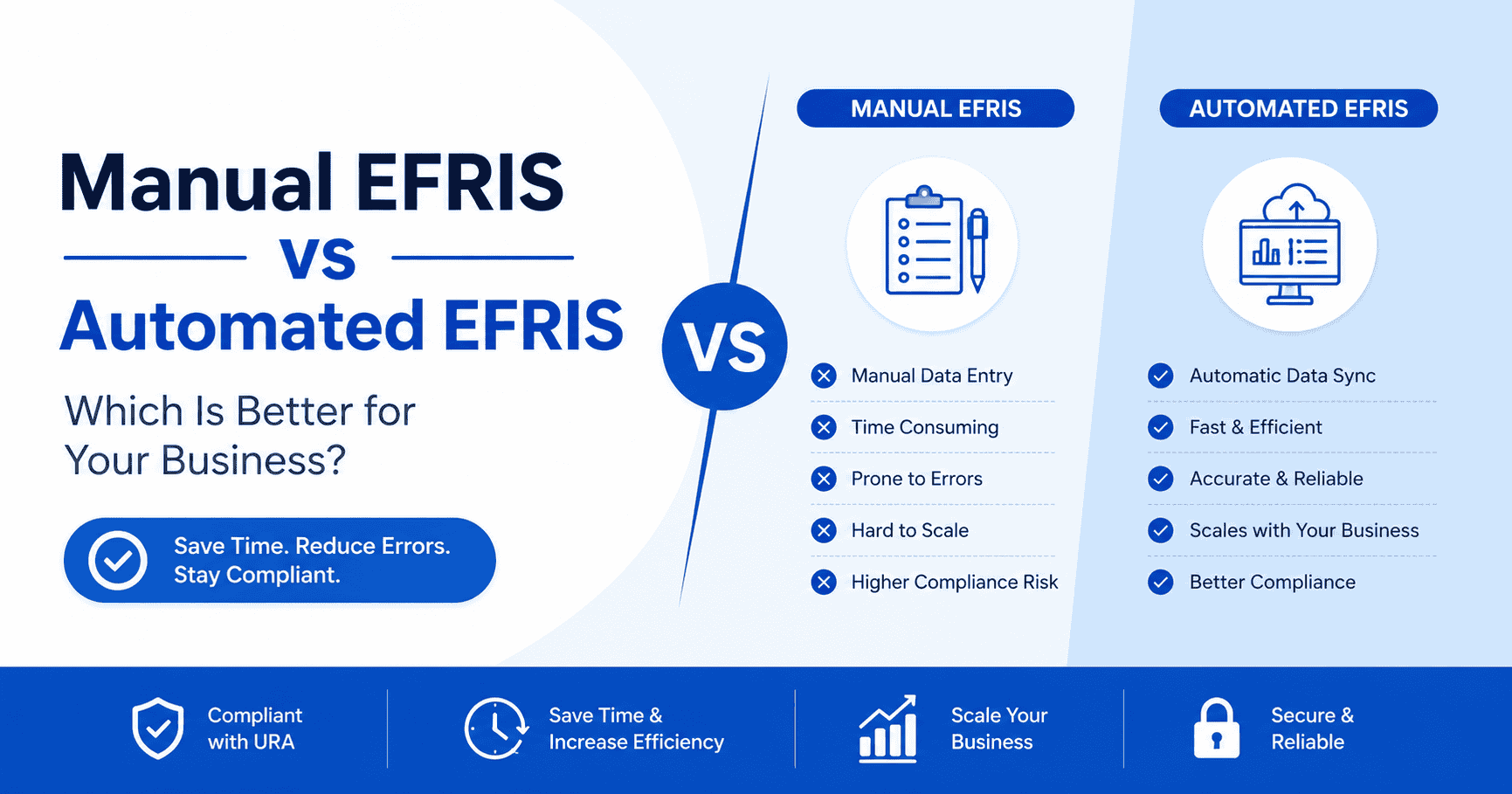
Building a POS, ERP, Hotel PMS, Accounting System, or E-commerce Platform? Integrate with EFRIS in days instead of months using EFRIS Simplified. Request a demo today.
Many Ugandan businesses still handle EFRIS compliance manually. Staff log into the EFRIS portal, create invoices one by one, enter product information, generate fiscal documents, and reconcile records at the end of the day.
While this approach works, it becomes increasingly difficult as a business grows.
An automated EFRIS solution integrates directly with your POS, ERP, accounting system, e-commerce platform, or hotel management software, allowing invoices and receipts to be transmitted to EFRIS automatically.
In this guide, we compare manual EFRIS processes with automated EFRIS integration to help you determine which option is best for your business.
Manual EFRIS refers to the process of entering and managing transactions directly through the EFRIS web portal.
Typical workflow:
This method is common among small businesses with low transaction volumes.
As transaction volumes grow, manual processes often become a bottleneck.
Automated EFRIS connects your business systems directly to URA through APIs.
When a sale is made in your POS, ERP, hotel management system, or accounting software, the invoice is automatically submitted to EFRIS without additional manual work.
Invoices are transmitted automatically, eliminating repetitive data entry.
Automation minimizes mistakes caused by manual typing.
Transactions are submitted consistently according to URA requirements.
Whether you process 10 invoices or 10,000 invoices per day, automation handles the workload.
Receipts and fiscal documents can be generated instantly without delays.
Sales data remains synchronized across your business systems and EFRIS.
| FeatureManual EFRISAutomated EFRIS | ||
| Data Entry | Manual | Automatic |
| Processing Speed | Slow | Fast |
| Human Errors | High | Low |
| Scalability | Limited | Excellent |
| Staff Effort | High | Low |
| Compliance Consistency | Moderate | High |
| Integration with Business Systems | No | Yes |
| Real-Time Submission | No | Yes |
Automation is especially valuable for:
Any business generating a significant number of transactions can benefit from EFRIS automation.
EFRIS Simplified provides a developer-friendly EFRIS integration platform that allows software vendors and businesses to automate compliance without dealing with the complexities of URA integrations.
With EFRIS Simplified, you can:
Instead of building and maintaining a complex EFRIS integration from scratch, your team can focus on delivering value to customers while EFRIS Simplified handles the compliance layer.
Manual EFRIS may be sufficient for businesses with very low transaction volumes, but it quickly becomes inefficient as operations grow.
Automated EFRIS reduces workload, improves accuracy, enhances compliance, and allows businesses to scale without increasing administrative overhead.
If your business software needs to communicate with EFRIS, automation is no longer a luxury—it is the most efficient path to sustainable growth.
Share this article