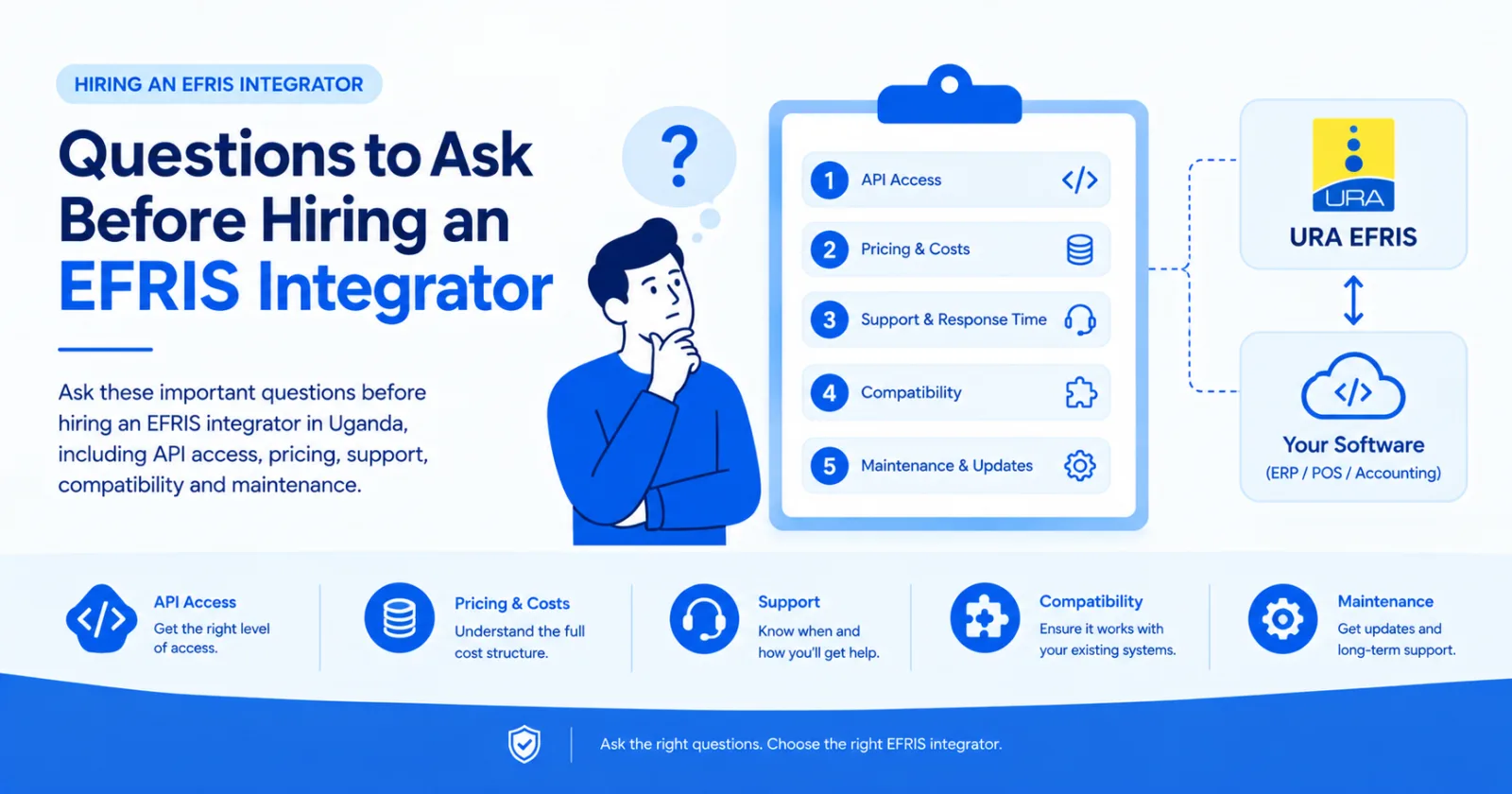
Ask these important questions before hiring an EFRIS integrator in Uganda, including API access, pricing, support, compatibility and maintenance.
Choosing an EFRIS integrator is an important operational decision.
The provider you select may become responsible for connecting your invoicing, accounting, POS or ERP system to Uganda Revenue Authority EFRIS.
Before signing a contract, you need to understand exactly what the provider can integrate, what support is included and who will be responsible when something goes wrong.
Here are the most important questions to ask.
Start with compatibility.
Tell the provider whether you use QuickBooks, Odoo, Tally, Zoho Books, an ERP, a POS system, an ecommerce platform or custom software.
Ask whether the provider has an existing connector or whether custom development will be required.
A good EFRIS integrator should help you keep the software that already works for your business.
API access is essential when your business uses custom software or needs a non-standard integration.
Ask whether the API is documented, secure and suitable for production use.
EFRIS Simplified provides a REST API that developers can use to connect ERP, POS, accounting and other business applications to EFRIS.
Your developers should not test new integrations using live customer transactions.
A sandbox environment allows the technical team to build, test and correct the integration before moving to production.
Ask whether sandbox access is included and whether it behaves similarly to the production service.
Do not assume that invoice submission is the only requirement.
Ask whether the provider supports:
E-invoices
E-Reciepts
Credit notes
Good or Service registration
Stock transfer
Best practices, etc
Choose a solution that can support both your current and likely future requirements.
Ask whether charges are based on:
Setup
Subscription
Number of businesses
Number of branches
Users
Transaction volume
API calls
Technical support
Request a complete cost breakdown so there are no surprises after implementation.
Ask who you contact when submissions fail.
Find out whether support includes technical troubleshooting, user assistance, failed transaction investigation and production onboarding.
EFRIS is part of your daily invoicing process. Delayed support can directly affect business operations.
EFRIS and your business software may change over time.
Ask who is responsible for maintaining compatibility, fixing issues and adapting the integration when requirements change.
With a managed platform such as EFRIS Simplified, the provider maintains the EFRIS integration layer while your team continues managing its primary business system.
Your business may add branches, products, systems or registered entities.
Ask whether the same integration can support growth without requiring a complete rebuild.
The right EFRIS integrator should reduce complexity rather than introduce another difficult system.
EFRIS Simplified is built to connect existing accounting, ERP, POS, ecommerce and custom applications to EFRIS.
You keep the software your team already knows. EFRIS Simplified handles the connection to URA EFRIS.
Share this article