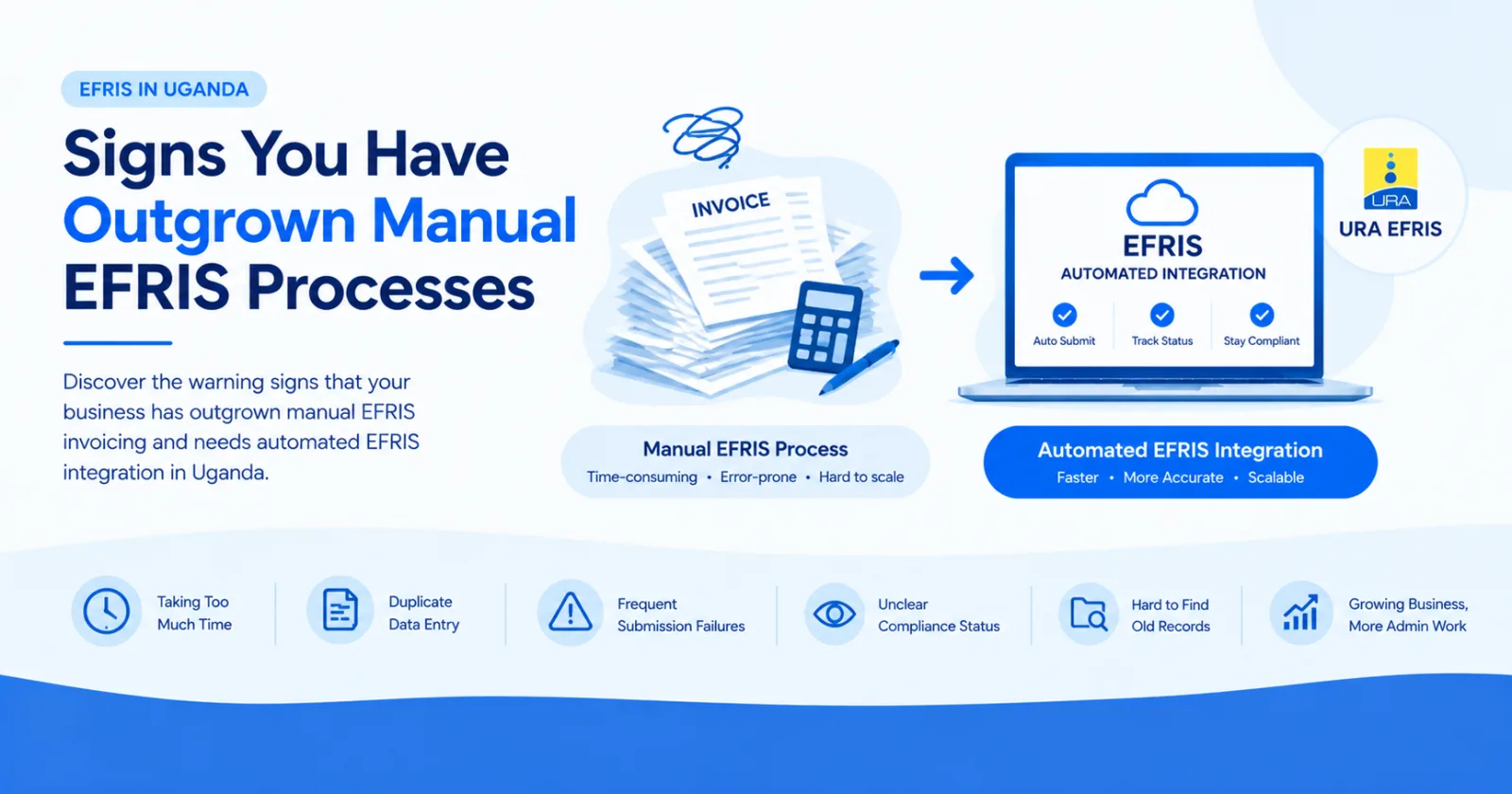
Discover the warning signs that your business has outgrown manual EFRIS invoicing and needs automated EFRIS integration in Uganda.
Manual EFRIS processes may be manageable when a business issues only a small number of invoices.
As transaction volumes increase, however, entering the same information into business software and EFRIS separately can become slow, expensive and difficult to control.
Here are the clearest signs that your business has outgrown manual EFRIS processing.
If an invoice is created in your accounting, ERP or POS system and then entered again into EFRIS, your team is doing duplicate work.
This consumes time and increases the risk of inconsistent records.
Automation allows the transaction to move from your existing system to EFRIS without requiring employees to repeat the entire process.
Customers should not have to wait while employees switch between systems and manually fiscalise transactions.
When the EFRIS process begins slowing down checkout, dispatch or invoice delivery, manual handling has become an operational bottleneck.
Manual entry can lead to:
Incorrect customer details
Wrong quantities
Pricing differences
Tax calculation mistakes
Missing invoices
Duplicate submissions
As the number of transactions grows, even a small error rate can create significant reconciliation work.
If the accounting system and EFRIS contain different information, employees must investigate and correct the differences.
Automated integration improves consistency because both processes begin with the same transaction data.
Manual EFRIS processes become harder to control when transactions originate from multiple branches, POS terminals, e-commerce stores or business systems.
A managed integration layer provides a more consistent way to submit transactions across the organization.
A critical business process should not depend entirely on one employee.
If EFRIS invoicing stops whenever a particular person is unavailable, the process is too fragile.
Automation reduces dependence on individual knowledge and creates a repeatable workflow.
Businesses with custom integrations may also outgrow their original technical implementation.
If developers spend increasing amounts of time maintaining EFRIS communication instead of improving the main business system, a managed integration platform may be more efficient.
EFRIS Simplified connects accounting, ERP, POS, e-commerce and custom software to URA EFRIS.
Your employees continue using their existing system while EFRIS Simplified handles the fiscalisation process.
For custom systems, developers can integrate through a REST API and test using a sandbox environment.
Manual EFRIS processing may have helped your business get started.
But as the business grows, automation becomes necessary for speed, consistency and control.
Share this article