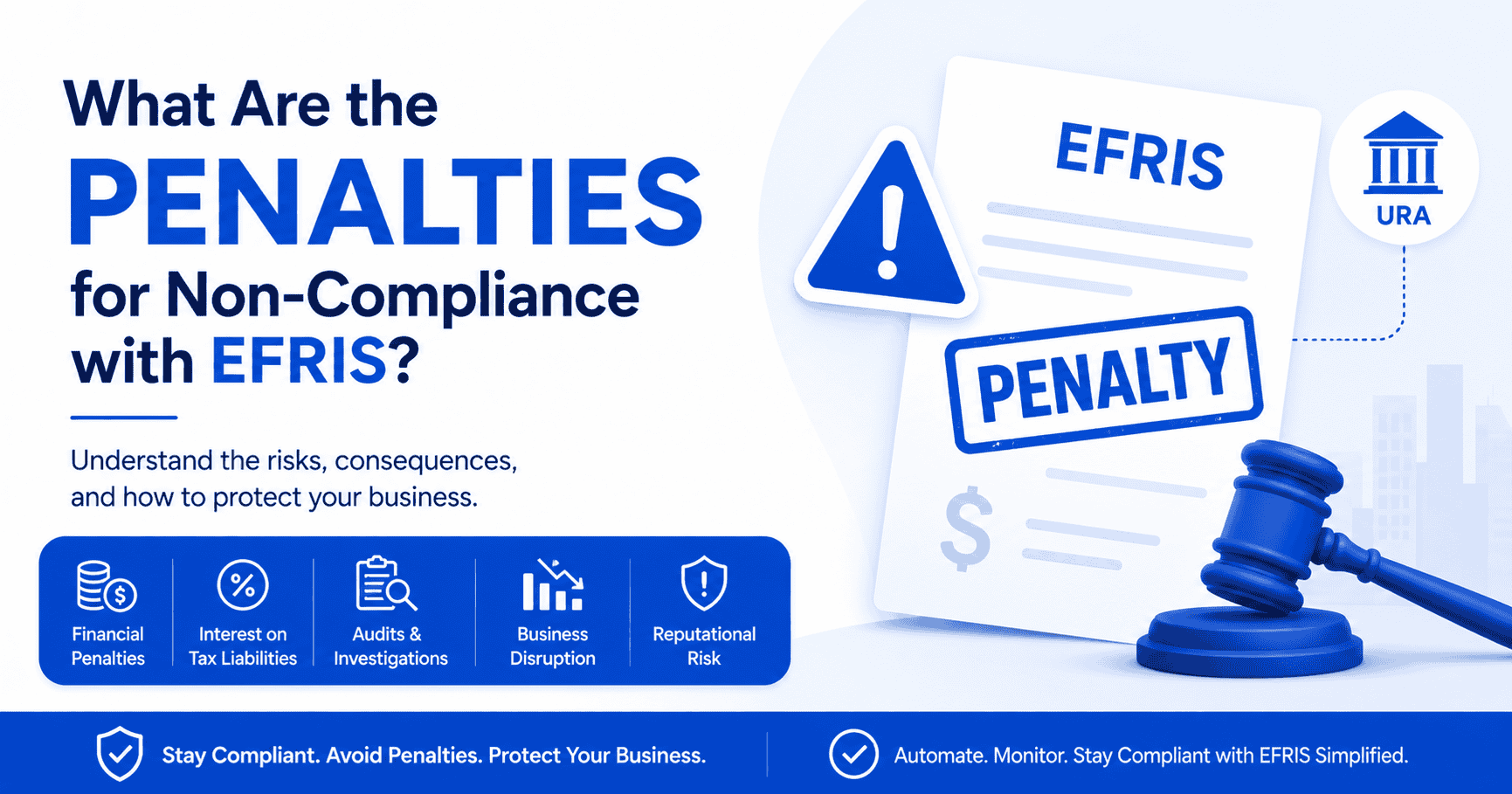
Non-compliance with EFRIS can lead to penalties, audits, interest charges, and operational disruptions. Learn the risks businesses face and how to stay compliant with URA requirements.
For many businesses in Uganda, EFRIS compliance can feel overwhelming.
Whether you're issuing invoices manually, managing multiple branches, or integrating your software with URA, it's easy to focus on the technical requirements and overlook the consequences of getting it wrong.
Unfortunately, non-compliance with EFRIS can expose businesses to penalties, audits, operational disruptions, and unnecessary financial risk.
In this article, we'll explore what EFRIS non-compliance means, the potential consequences businesses may face, and how to reduce compliance risks.
EFRIS (Electronic Fiscal Receipting and Invoicing Solution) is URA's electronic invoicing and receipting platform.
Businesses required to use EFRIS must ensure that:
Compliance is not simply about registering for EFRIS. It also involves using the system correctly and consistently.
Non-compliance can occur in several ways.
Examples include:
Even unintentional mistakes can create compliance issues if they result in inaccurate reporting.
The exact consequences depend on the circumstances and applicable tax laws, but businesses may face several forms of enforcement action.
URA may impose penalties for failure to comply with tax and invoicing requirements.
The amount can vary depending on:
Financial penalties can quickly become significant, especially for businesses processing large transaction volumes.
Where non-compliance results in underreported tax liabilities, additional interest charges may accrue over time.
This can substantially increase the total amount payable beyond the original tax obligation.
If URA determines that reported transactions do not accurately reflect business activity, it may conduct assessments based on available information.
This can result in additional tax liabilities and administrative burdens for the business.
Repeated compliance issues may increase the likelihood of audits and reviews.
During an audit, businesses may be required to provide:
Maintaining accurate records is therefore essential.
Compliance issues can consume valuable time and resources.
Management and staff may need to spend significant effort:
This can distract teams from serving customers and growing the business.
Customers, suppliers, investors, and partners expect businesses to operate within regulatory requirements.
Repeated compliance issues can damage confidence and create unnecessary reputational concerns.
Many businesses do not become non-compliant intentionally.
Common causes include:
Businesses relying on manual invoice entry are more likely to experience:
Employees unfamiliar with EFRIS requirements may unknowingly make mistakes during invoice creation and reporting.
Businesses using custom software may encounter:
Without proper monitoring, these issues can go unnoticed.
Missing or incomplete records make it difficult to demonstrate compliance when questions arise.
The good news is that most compliance risks can be minimized through proper processes and automation.
Keep complete records of:
Ensure invoices are successfully transmitted and accepted.
Failed submissions should be investigated and resolved promptly.
Tax classifications, commodity codes, and related information should remain accurate and up to date.
Businesses should use systems that:
EFRIS Simplified was designed to reduce the operational risks associated with EFRIS compliance.
Instead of manually managing technical requirements, businesses can automate critical compliance processes.
EFRIS Simplified provides:
By reducing manual intervention, businesses can significantly lower the likelihood of compliance-related mistakes.
Accidental errors can still create compliance issues. Businesses should have processes in place to detect and correct problems as quickly as possible.
Yes, EFRIS errors result in a mandatory UGX 6,000,000 penalty on every erroneous invoice.
Businesses should monitor submission confirmations and maintain records of all successful and failed transactions.
Automation can significantly reduce the risk of missed submissions, data entry errors, and compliance oversights when implemented correctly.
EFRIS compliance is not just a regulatory requirement, it is an important part of protecting your business from unnecessary financial and operational risk.
While the specific consequences of non-compliance vary, businesses that fail to maintain accurate records and submit transactions correctly may face penalties of UGX 6,000,000 per invoice.
The most effective approach is to build reliable compliance processes and use tools that make compliance easier, more accurate, and more consistent.
With the right systems in place, EFRIS compliance becomes a routine business process rather than a constant source of concern.
To get started with EFRIS integration call/WhatsApp us on +256 704 031 764
Share this article