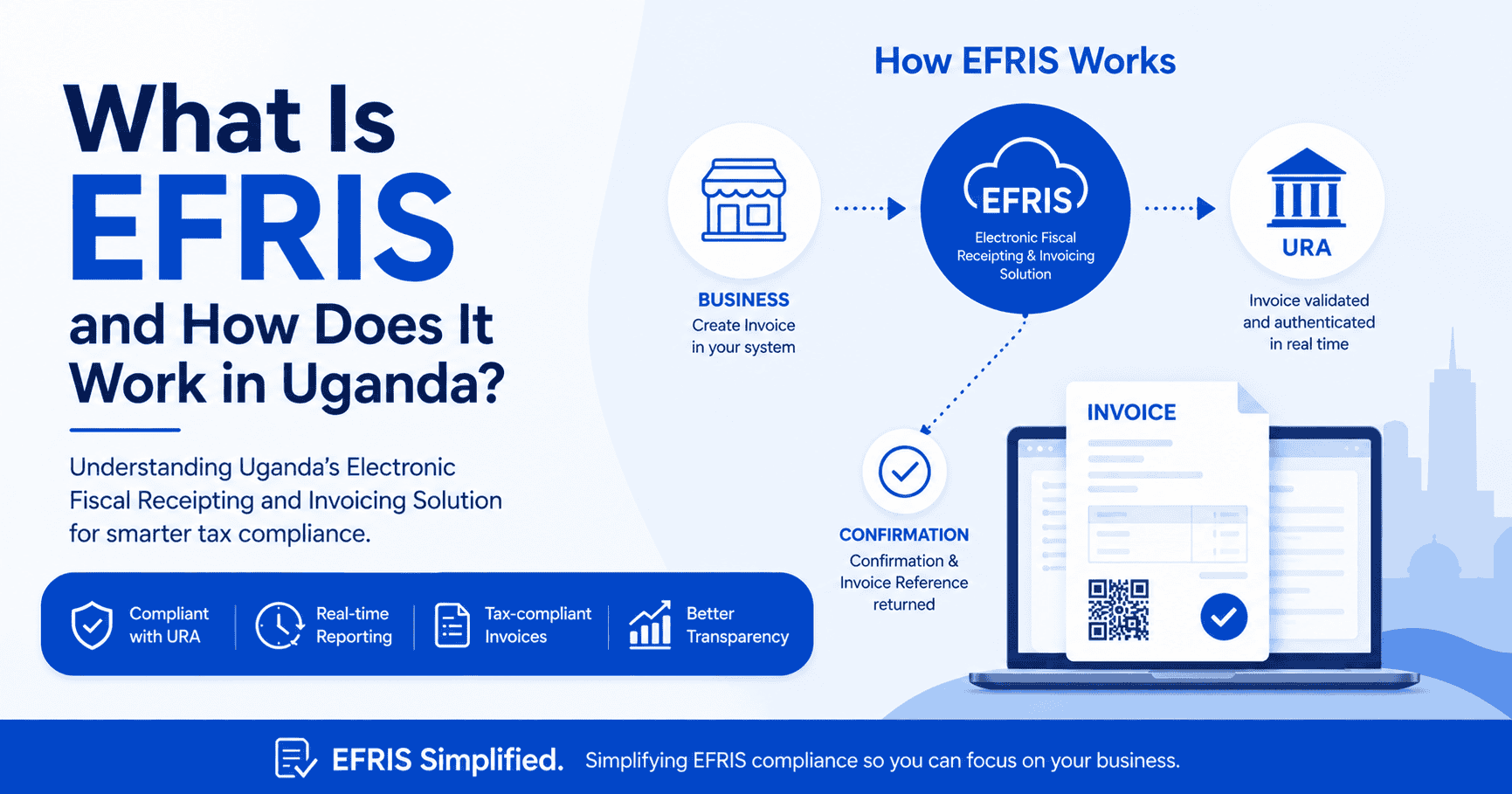
What is EFRIS and how does it work in Uganda? Learn how the Electronic Fiscal Receipting and Invoicing Solution (EFRIS) helps businesses comply with URA requirements, issue tax-compliant invoices, and report transactions in real time.
If you run a business in Uganda, you've probably heard of EFRIS.
Whether you're issuing invoices, selling products, running a retail store, operating a hotel, or managing an accounting system, EFRIS has become an important part of tax compliance.
But what exactly is EFRIS, and how does it work?
In this guide, we'll explain what EFRIS is, why URA introduced it, how it works, and what businesses need to know to stay compliant.
EFRIS stands for Electronic Fiscal Receipting and Invoicing Solution.
It is a system introduced by the Uganda Revenue Authority (URA) to improve tax administration and enable real-time reporting of business transactions.
The system allows businesses to:
Instead of relying on paper records and manual reporting, EFRIS enables businesses and URA to exchange transaction information electronically.
URA introduced EFRIS to:
By receiving transaction information electronically, URA can verify sales and tax declarations more efficiently.
For businesses, this means faster, more accurate compliance processes and reduced paperwork.
EFRIS requirements depend on the nature of your business and URA's regulations.
Businesses commonly required to use EFRIS include:
If you're unsure whether your business must use EFRIS, you should consult URA or your tax advisor.
At a high level, EFRIS acts as a bridge between your business and URA.
When you create an invoice, transaction information is submitted electronically to URA through the EFRIS platform.
The process typically looks like this:
A sale occurs in your business.
This could happen through:
The invoice contains information such as:
The invoice information is transmitted electronically through EFRIS.
URA validates the submission and checks that it meets compliance requirements.
Once accepted, URA generates a confirmation and assigns the invoice an official EFRIS reference.
The invoice becomes a tax-compliant document recognized by URA.
The business receives confirmation that the invoice was successfully processed.
This information can include:
Both the business and URA maintain records of the transaction for future reference, audits, and compliance verification.
There are several ways to interact with EFRIS.
Businesses can log in directly to the URA EFRIS portal and manually create invoices.
This works for businesses with low transaction volumes but can become time-consuming as operations grow.
Many accounting platforms integrate with EFRIS, allowing invoices to be submitted automatically.
Retail businesses often connect their POS systems directly to EFRIS so sales are transmitted automatically.
Larger organizations frequently integrate their ERP software with EFRIS to automate compliance across departments.
While EFRIS improves compliance, many businesses encounter challenges such as:
For businesses without technical teams, these challenges can be difficult to manage.
EFRIS Simplified removes the technical complexity of EFRIS compliance.
Instead of worrying about:
Businesses can focus on their operations while EFRIS Simplified handles everything in the background.
With EFRIS Simplified you can:
The result is a simpler, more reliable path to EFRIS compliance.
Requirements vary depending on the nature of the business and URA regulations. Businesses should consult URA or a qualified tax advisor to determine their obligations.
Yes. Businesses can use the URA EFRIS portal directly to create and manage invoices.
Yes. Many businesses automate EFRIS submissions through integrations with accounting software, POS systems, ERP systems, or platforms such as EFRIS Simplified.
Modern EFRIS integration platforms often include automatic retry mechanisms that resubmit transactions when services become available again.
EFRIS is Uganda's electronic invoicing and receipting system designed to improve tax compliance and simplify transaction reporting.
While businesses can use EFRIS manually through the URA portal, many organizations choose automated solutions to reduce workload, improve accuracy, and maintain compliance more efficiently.
Understanding how EFRIS works is the first step toward choosing the right approach for your business and ensuring you remain compliant as your operations grow.
Share this article