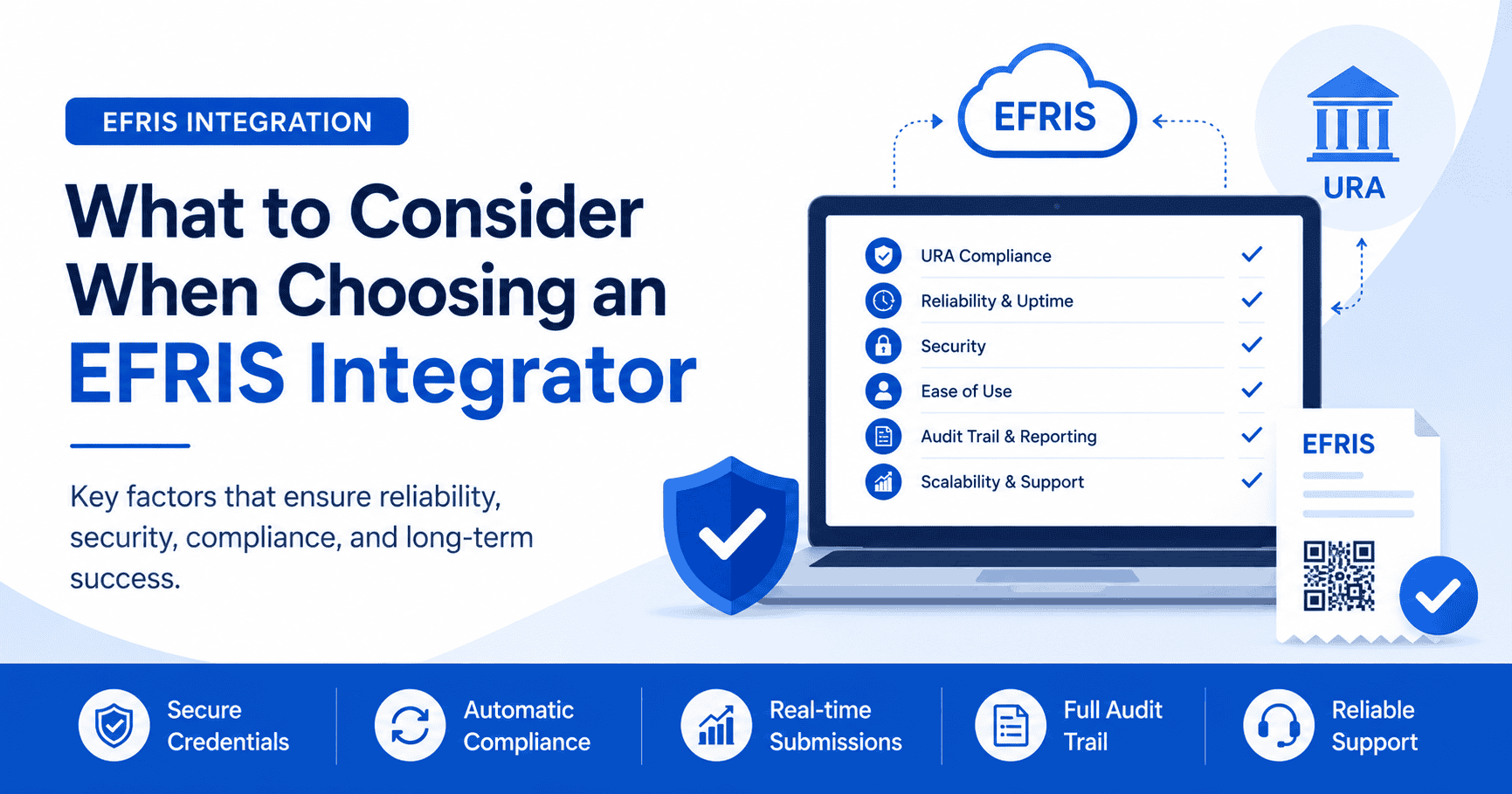
Choosing the right EFRIS integrator can save your business time, reduce compliance risk, and eliminate technical headaches. Learn the key factors to evaluate before selecting an EFRIS integration provider.
Choosing an EFRIS integration provider is an important decision for any business operating in Uganda.
Your EFRIS integrator sits between your business and URA. Every invoice, receipt, product update, and compliance record flows through that connection. The wrong choice can lead to failed submissions, compliance issues, downtime, and unnecessary costs.
While many providers claim to offer EFRIS integration, not all solutions are built with reliability, security, and long-term compliance in mind.
Here are the most important factors to consider before selecting an EFRIS integration partner.
The primary reason for integrating with EFRIS is compliance.
Your integrator should ensure every invoice is submitted correctly, authenticated successfully, and transmitted to URA in real time.
If compliance depends on manual processes, staff intervention, or technical expertise, mistakes become inevitable.
Look for a provider that:
A good EFRIS integrator should make compliance feel effortless.
Many businesses focus on feature lists but overlook reliability.
What happens when URA's systems become slow or temporarily unavailable?
A robust EFRIS platform should automatically:
Without these safeguards, staff may spend hours investigating failed submissions and manually resending invoices.
The best integrations continue working even when URA experiences temporary disruptions.
Your EFRIS credentials provide access to critical tax and compliance systems.
Before selecting an integrator, ask:
A professional platform should use strong encryption, strict access controls, and secure credential management practices.
Your credentials should never be exposed to unauthorized personnel or stored in plain text.
Many EFRIS solutions assume businesses have dedicated IT teams.
Most businesses do not.
The ideal solution should allow you to:
You shouldn't need a software developer, technical consultant, or weeks of training to get started.
If a platform feels complicated during onboarding, it will likely remain complicated long-term.
Compliance isn't only about submitting invoices.
It's also about proving what happened when questions arise.
A quality EFRIS integrator should maintain:
This information becomes invaluable during audits, investigations, and troubleshooting.
Without a complete audit trail, resolving compliance disputes can become difficult and time-consuming.
Businesses often grow beyond a single location.
If you operate multiple branches, stores, warehouses, or business entities, your EFRIS solution should support them from a single dashboard.
Look for features such as:
This eliminates the need to manage separate systems for each location.
URA requirements evolve over time.
Tax rates change.
Commodity classifications change.
Exchange rates change.
Submission requirements change.
Your EFRIS provider should continuously maintain and update the platform so you don't have to monitor regulatory changes yourself.
A solution that requires manual updates introduces unnecessary risk.
The best EFRIS integrations stay synchronized with URA requirements automatically.
Even if your business doesn't need custom integrations today, your requirements may change in the future.
A strong EFRIS platform should offer:
This flexibility ensures your EFRIS solution can grow alongside your business systems.
Many businesses focus solely on initial costs.
Instead, consider the total cost over several years.
Building and maintaining a custom EFRIS integration often involves:
These costs frequently exceed the cost of a managed EFRIS platform.
A fully managed solution allows your team to focus on serving customers instead of maintaining compliance infrastructure.
EFRIS integration is more than simply connecting to an API.
Behind every successful submission are multiple technical processes:
The best providers absorb this complexity entirely, allowing businesses to operate without worrying about technical details.
EFRIS Simplified was built specifically to remove the technical burden of EFRIS compliance.
Businesses choose EFRIS Simplified because it provides:
Most importantly, businesses can focus on running their operations while EFRIS Simplified handles every technical requirement in the background.
The right EFRIS integrator should do more than connect you to URA.
It should reduce risk, save time, improve reliability, strengthen security, and simplify compliance.
Before making a decision, evaluate providers based on reliability, security, automation, ease of use, and long-term operational costs—not just pricing alone.
The best EFRIS solution is the one that lets you forget about EFRIS altogether and focus entirely on growing your business.
Share this article