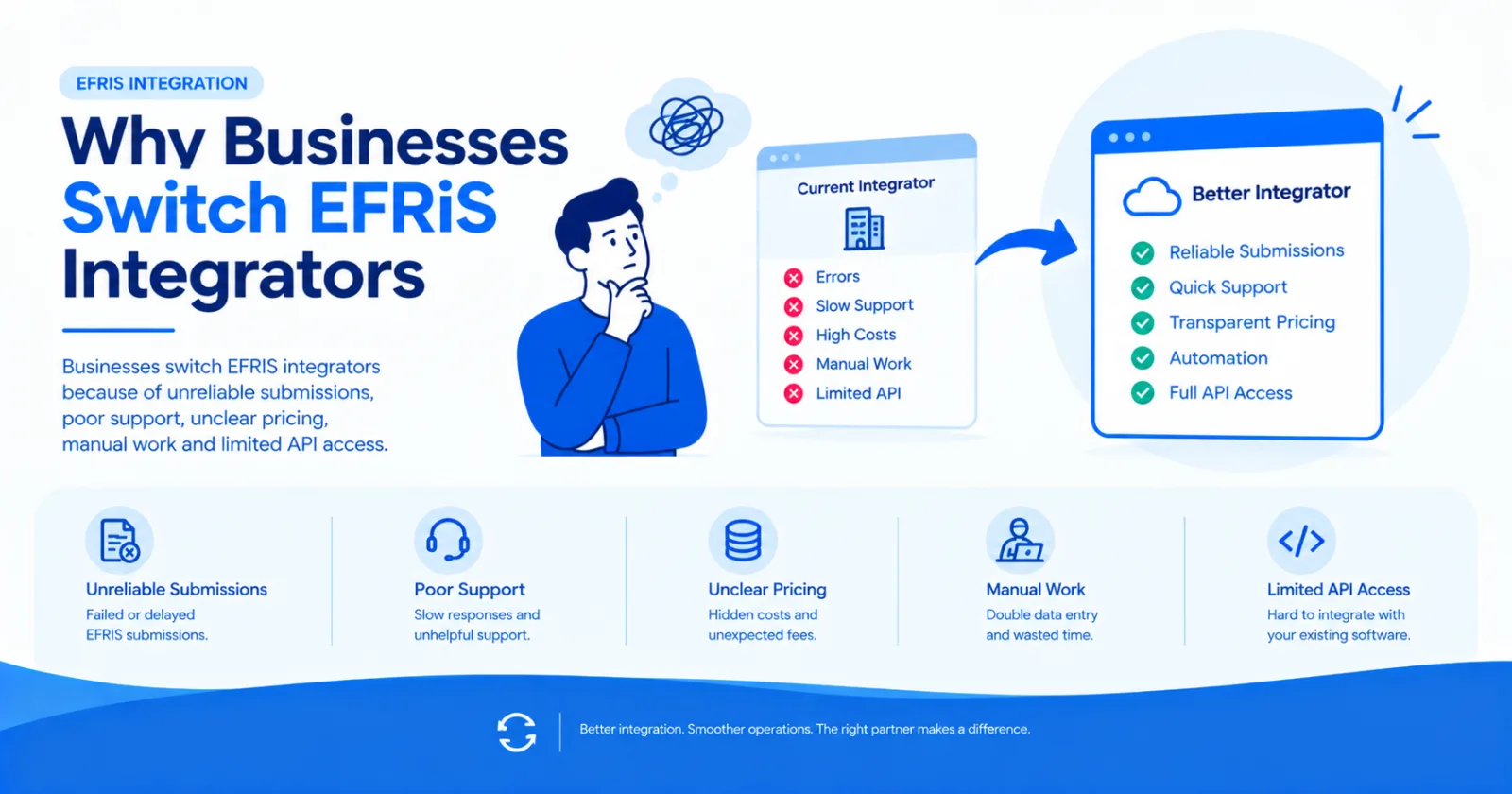
Learn why businesses switch EFRIS integrators because of unreliable submissions, poor support, unclear pricing, manual work and limited API access.
Changing an EFRIS integration provider can feel risky, especially when the existing solution is connected to daily invoicing.
However, businesses often switch providers when the current integration becomes unreliable, expensive or difficult to maintain.
Here are the most common reasons organisations move to a different EFRIS integrator.
An EFRIS integration should work consistently.
Repeated failures, unexplained errors and delayed submissions can affect invoicing, customer service and financial reporting.
When the provider cannot identify or resolve recurring problems, businesses begin looking for a more reliable alternative.
EFRIS problems can interrupt normal business operations.
If support requests remain unanswered while invoices are failing, the business carries the operational risk.
Companies often switch to providers that offer clearer communication and more dependable technical assistance.
A business may start with one accounting system and later introduce a POS, ERP, ecommerce platform or custom application.
An integration built around only one system may become limiting.
Businesses switch when they need a provider that can support several platforms through one managed EFRIS integration layer.
Some integrations only automate part of the process.
Employees may still need to copy data, correct transactions manually or move between several systems.
If the solution does not significantly reduce administrative work, the business may look for a more complete integration.
Businesses may switch because of:
Hidden setup charges
High per-transaction fees
Separate support fees
Expensive custom changes
Charges for additional branches
Unpredictable renewal costs
Transparent pricing helps businesses understand the long-term cost of the service.
Custom software and growing ERP platforms often require API-based integration.
When the current provider does not offer a documented REST API, the business may be forced to maintain fragile manual processes or custom workarounds.
EFRIS Simplified provides API access for developers connecting ERP, POS, accounting and other applications.
Switching providers should be planned carefully.
The new integrator should review your existing software, transaction flow, business entities and EFRIS requirements before production migration.
Testing should be completed before the old integration is disabled.
EFRIS Simplified is designed for businesses that want a flexible, managed connection between their existing software and URA EFRIS.
You do not need to replace your accounting, ERP or POS system simply because you are changing integrators.
Keep your software. Improve your EFRIS integration.
Share this article